
I always relish the opportunity at the beginning of the year for a restart. After a month of holiday fun, traveling, having company, more sugar then normal, and even enjoying the rest that comes after Christmas, I find that I long to come back to a routine that anchors us back into some consistency. It is also a great time to take stock in how the year is going to see what changes need to be made. Here are some ideas for making necessary shifts in the New Year.
1. Pray and receive help from the Holy Spirit.
This is an often overlooked, but very important first step. As parents, it can feel like it is all up to us to make the right decisions that will allow our children to grow up to love God, be well educated, mature adults who contribute to society and lead fruitful lives. The truth is that our role as their parents is a partnership with God and the fruit of our children’s lives are in His hands not ours. Here are a few versus to ponder:
- “All your children will be taught by the LORD, and great will be their peace.” Isaiah 54:13
- “I will lift up my eyes to the mountains; From where shall my help come? My help comes from the LORD, Who made heaven and earth.” Psalm 121:1-2
- “Trust in the Lord with all your heart and lean not on your own understanding; in all your ways acknowledge him, and He will make your paths straight.” Proverbs 3:5-6
- “Sow for yourselves righteousness; reap steadfast love; break up your fallow ground, for it is the time to seek the Lord, that he may come and rain righteousness upon you.” Hosea 10:12
- “You will seek me and find me, when you seek me with all your heart” Jeremiah 29:13
Ask God for help, diligently sow seeds of the gospel and Biblical truth into the lives of your children. Model a life of kindness, selflessness, and service to God and family. As we commit our lives to the Lord, with surrendered hearts and prayerfully seek Him regarding our children, we can trust Him to help us be the parents our children need us to be. We can also trust that He is working in the hearts of our children teaching them directly.
2. Evaluate where you are, face what has not been working, think about why, and acknowledge what has been done well. Here are a few questions I like to ponder:
- What are you seeing that is good? Interests that you want to lean into, friends that you want to spend more time with, skills that your kids may have acquired that they did not have a few months ago, goals that have been achieved
- What are you seeing in your home that needs to stop? Attitudes of the heart & bad habits (for both kids and parents)
- What needs to be added to the daily routine to help solidify a skill set or meet a need? Multiplication Facts need to be memorized, daily quiet reading time, one on one time with mom/dad, training in a morning routine, more time outside
- What needs to be taken away because it is taking away from your family’s peace and connection? An extra curricular activity that is making your family consistently too busy to be present, a curriculum that is not meeting your child’s needs, too much screen time
3. Make a Visual Schedule to get back on track with Homeschooling Expectations and Daily Routines.
This year we knew we were going to need to reset expectations when it comes to daily habits, completing homeschool work, and attitudes in the home. When it came to resetting expectations around completing homeschool work and sticking to habits such as a morning routine, I have found that a visual schedule is helpful. I looked at the visual schedule we have used in the past and reworked it to reflect our current needs. I played around with a few different formats.
First, I made a homeschool schedule for myself to follow which is the picture on the bottom right. Secondly, I made a schedule for each of my kids including individual work that they each have to do each day before earning screen time. Lastly, I converted that schedule into a picture schedule (featured on the bottom left) because my kids said that was easier to follow. You can find templates for each of these here: Daily Homeschool Schedule Templates.
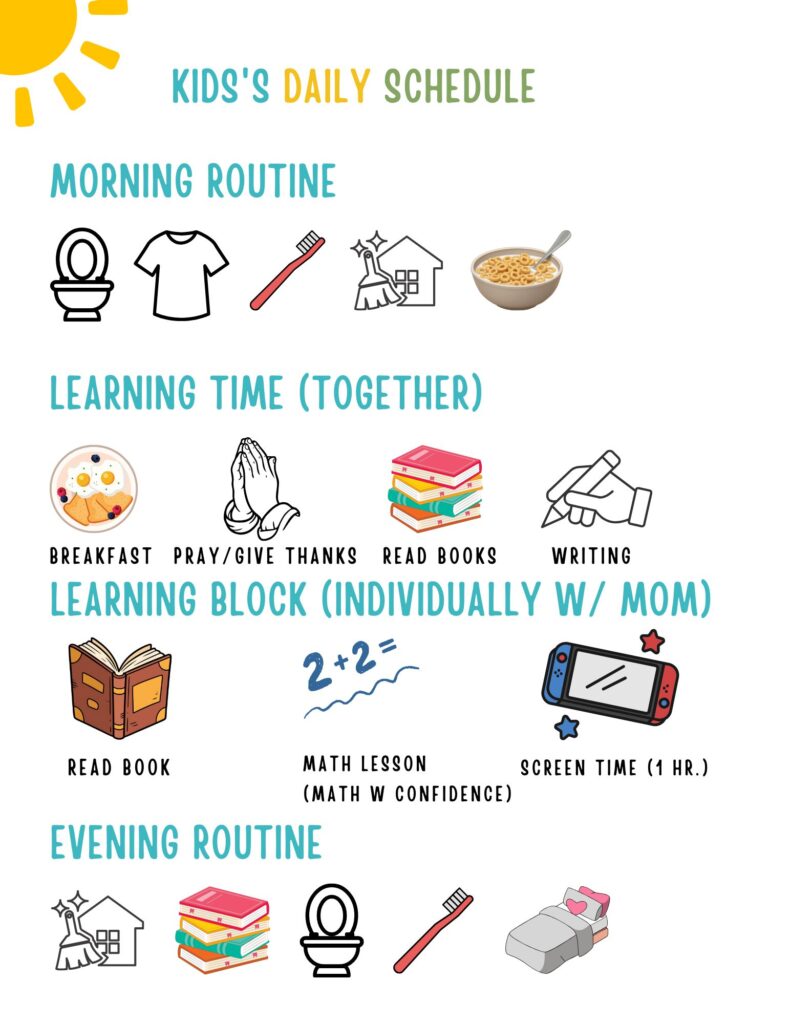
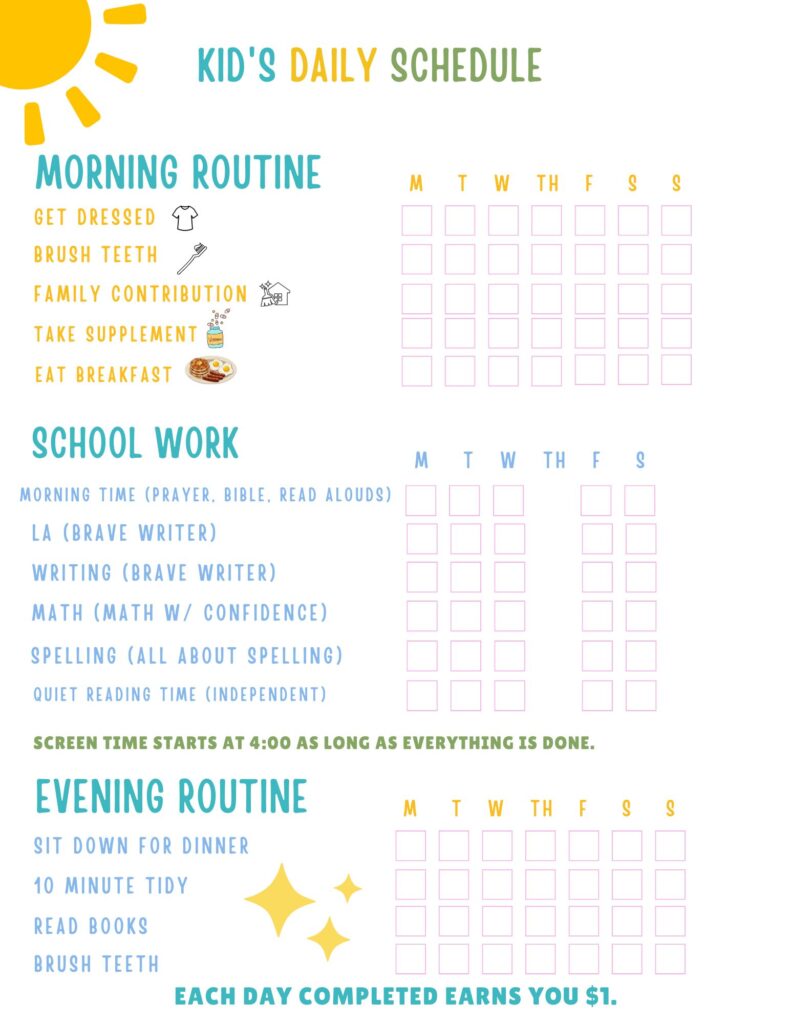
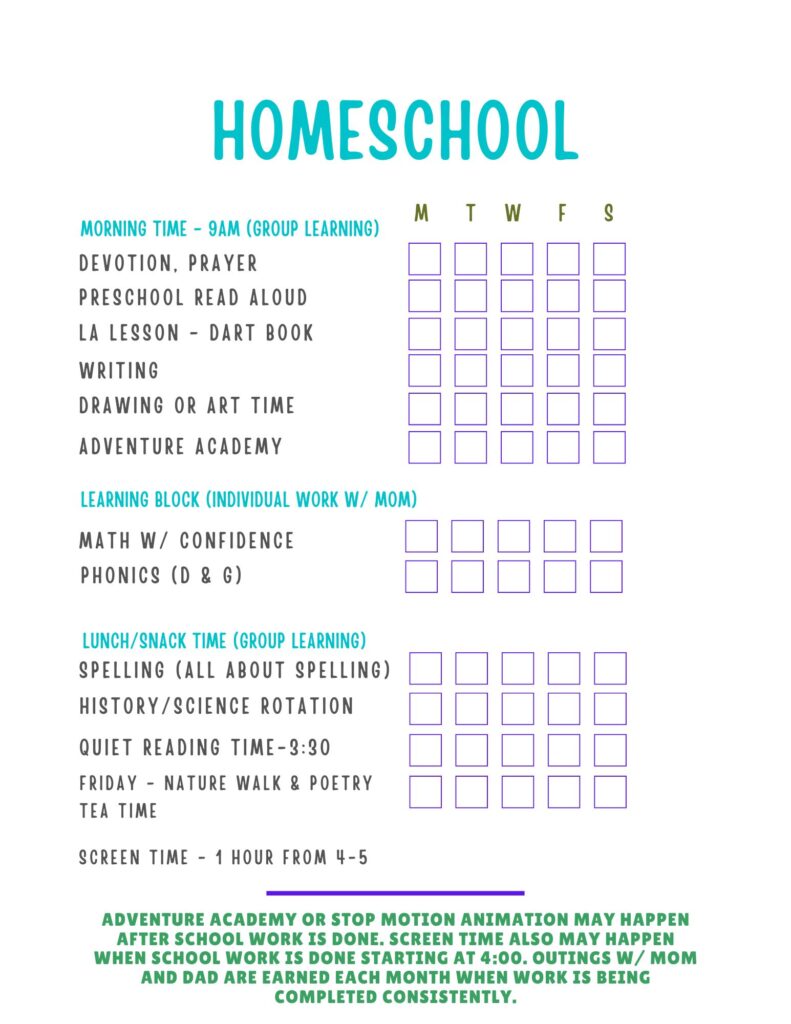
You may notice there are no times on here except for when screen time is allowed to start (4:00). Any of you who have been homeschool for long will know that timed schedules are almost always doomed to fail . That does not mean you do not have a loose idea of when things need to be done in order for the full scope of the work to be complete, but I find that we thrive with a consistent order and clear boundaries around what is allowed to be done when.
For example, before play time begins, morning routines need to happen. Before screen time begins, all work needs to be done for the day. Before we have our after dinner treats, the family does a quick clean up together. Do we stick to this religiously everyday? No, but it does give us anchor points throughout the day to keep us all accountable to the work we are responsible for.
This is loosely what we aim for each day:
-Wake Up/Morning Routine (brush teeth, get dressed, do a family contribution)
-Play
-Gather for breakfast & read alouds (we aim for a devotion, picture book, and chapter book with narration)
-Language arts lesson from Brave Writer (this corresponds to the chapter book we are reading)
-Play Break
-Learning blocks for each child occur during the afternoon and are individual lessons of Phonics, Math, and Reading done with mom.
4. Check in on Connection and Motivation

After completing each child’s schedule, I sat down with them and walked them through it. We set goals for their school work that were short and achievable. For example, I put a post-it note in their Math & Phonics curriculum that was 20 lessons ahead of where they were. Once they get to both post-it notes, they earn a one on one date with a parent. This helps create motivation around completing the work because they can see the progress they are making towards the post it note versus completing the whole book (which feels unachievable).
Even though they had not achieved their goals yet, we scheduled a one on one coffee date with each child where we took games and sipped on hot chocolate. In homeschooling, it can be so challenging to maintain connection with each child and not feel like you are nagging them to do things all of the time. These coffee dates were so special and helped make sure the kids felt really connected to me before we even began diving into the new routine.
5. Schedule Family Meetings to lean into any attitude or heart changes you perceive need to take place.
We do family meetings once or twice a week depending on how busy we are. These are crucial times for our family to have fun and lay or reset expectations in our home.
We aim to keep it brief… like 10 minutes or less. We start with something fun like a game of charades or a dance party. We give everyone a heads up about any events that are coming up in the week and then we spend a brief amount of time discussing one area of change. This could be cleaning up after yourselves, how to have integrity, what to do when you are angry, and treating one another with respect. It is good to keep an eye on the attitudes in the home. Having regular check ins like this with your spouse and kids allows you to course correct before things go to far off the rails.
I hope this helps you bring your homeschool and your home back to a place of peace and joy.
